What Are Peptides?
RESEARCH LIBRARY • FOUNDATIONS • PEPTIDE SCIENCE • RESEARCH LITERACY
Quick Answer
Peptides are molecules made from amino acids linked together by chemical bonds called peptide bonds. They occur naturally throughout biology and participate in processes ranging from hormone signaling and metabolism to communication between cells.
Peptides also occupy an interesting middle ground in biomedical research. They are generally larger and more structurally complex than conventional small molecules, but smaller than most proteins. Depending on their sequence and structure, peptides can interact with receptors and other biological targets with considerable specificity. NCBI
But there is an important distinction:
A molecule being a peptide tells us what kind of molecule it is. It does not tell us whether that particular peptide is safe, effective, medically useful, or approved for human use.
Those questions require evidence specific to the individual compound.
The Big Picture
Think of amino acids as letters.
A single letter does not communicate very much on its own. Arrange letters into different sequences, however, and they create entirely different words.
Peptides work somewhat similarly.
A peptide is built from a sequence of amino acids. The identity, order, chemical properties, modifications and three-dimensional behavior of that sequence help determine how the molecule interacts with biological systems.
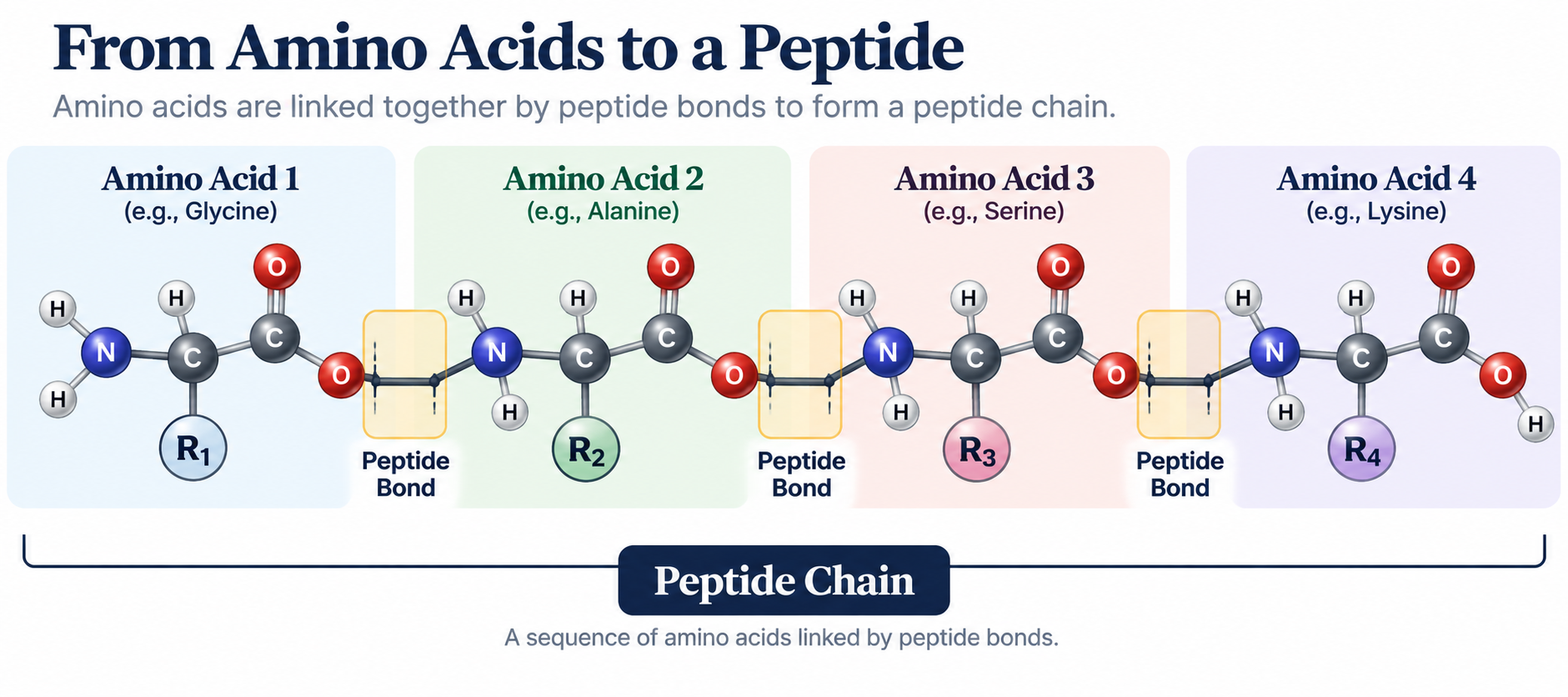
Amino acids are connected through peptide bonds. Chemically, a peptide bond forms between the carboxyl group of one amino acid and the amino group of another. NCBI
A simplified representation looks like this:
Those amino acids together form a peptide chain.
Change the sequence and you can change the molecule.
Change the length and you can change its properties.
Change one amino acid and, in some cases, biological activity may change significantly.
That relationship between sequence, structure and function is fundamental to peptide biology.
Peptides vs. Proteins
The boundary between a peptide and a protein is not perfectly universal.
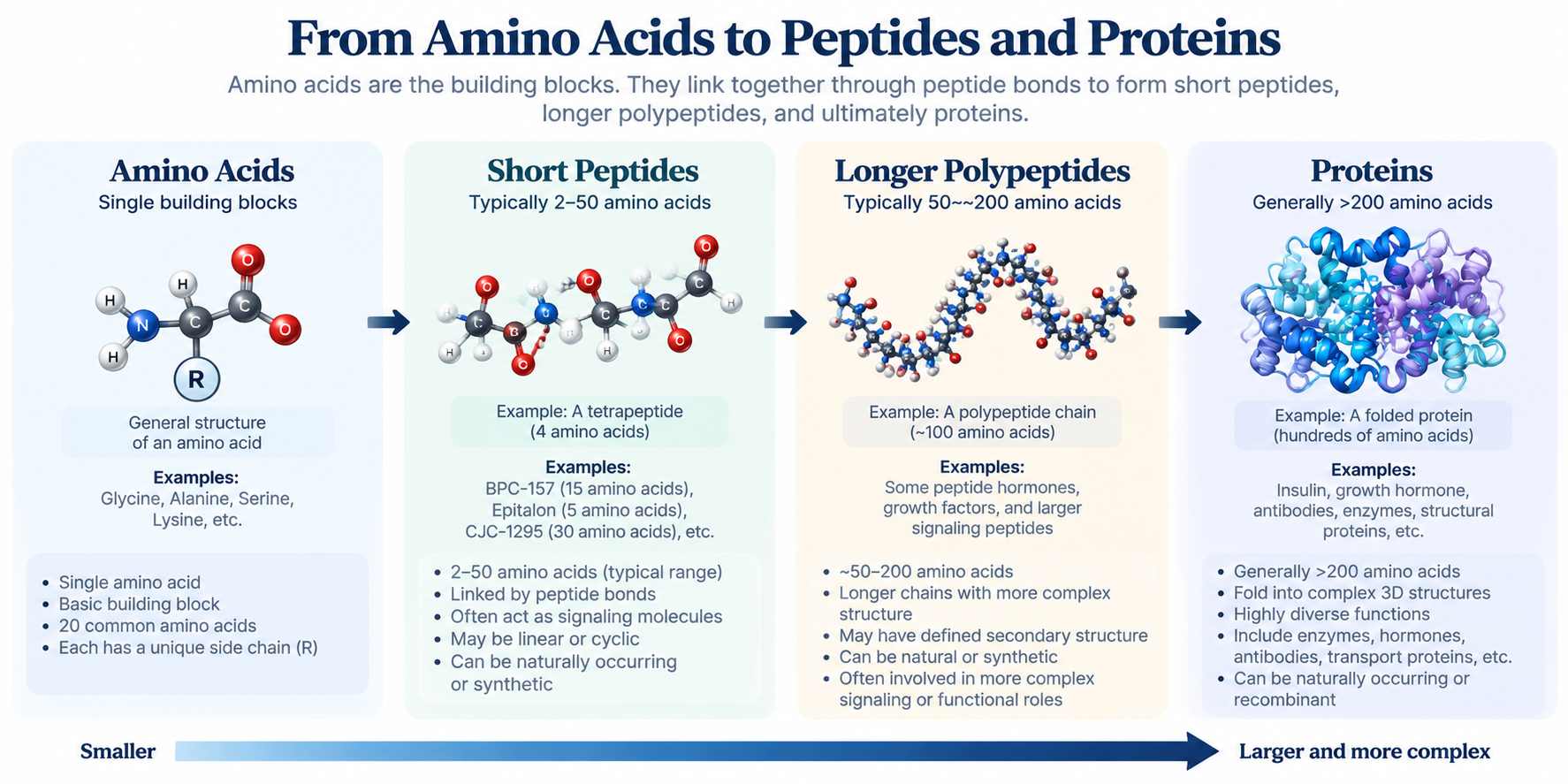
A commonly used biochemical convention describes peptides as relatively short chains of amino acids, often around 2 to 50 amino-acid residues, while longer chains are generally classified as proteins. Other classification systems use somewhat different boundaries. NLM's MeSH vocabulary, for example, distinguishes oligopeptides and polypeptides differently. NCBI
So it is more useful to understand the continuum than to become overly attached to one numerical cutoff:
Amino acids → short peptides → longer polypeptides → proteins
Proteins can contain hundreds or thousands of amino acids and often fold into elaborate three-dimensional structures. Peptides are generally smaller, although they too may adopt specific structures, form cycles or undergo chemical modifications. NCBI
Peptides and proteins are both constructed from amino acids. The distinction between them is useful but does not have one universally applied numerical cutoff.
Peptides Are Part of Normal Biology
The word peptide sometimes sounds like it refers to a modern laboratory invention.
It doesn't.
The human body naturally produces many peptides.
Some function as hormones or signaling molecules, helping cells and tissues communicate. Peptide hormones are important regulators of physiological homeostasis, and peptide signaling participates in processes involving metabolism, endocrine function and many other biological systems. PubMed
Well-known naturally occurring peptide or peptide-based signaling molecules include:
Insulin
Central to glucose regulation.
Glucagon
Participates in regulation of glucose availability.
Oxytocin
Functions as a peptide hormone and neuropeptide.
Vasopressin
Participates in water balance and vascular physiology.
Gonadotropin-releasing hormone, or GnRH
Participates in regulation of reproductive hormone signaling.
Research into several of these natural human hormones helped establish the foundation for modern therapeutic-peptide development. Nature
How Peptide Signaling Works
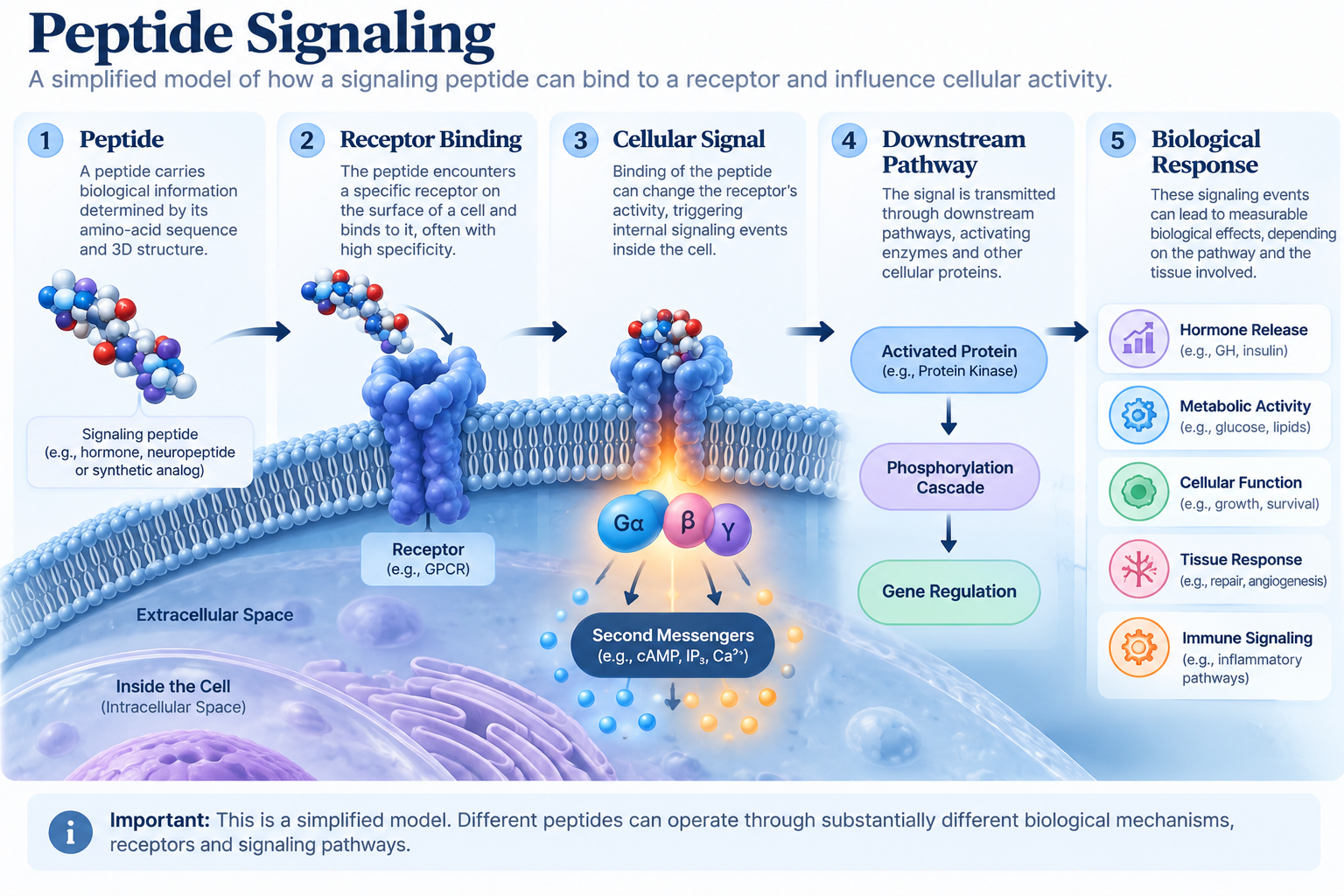
One useful way to understand many signaling peptides is to imagine a molecular message and receiver.
1. A peptide carries information
Its amino-acid sequence and three-dimensional characteristics give the molecule particular chemical properties.
2. The peptide encounters a biological target
For many signaling peptides, that target is a receptor located on or associated with a cell.
3. Binding changes receptor activity
If the peptide interacts appropriately with that receptor, it may activate, inhibit or otherwise modify signaling.
4. The signal is transmitted
The receptor can initiate events inside the cell.
5. Biology responds
Depending on the pathway, downstream effects can involve metabolism, hormone release, cellular communication or other physiological processes.
Many peptide therapeutics act through G protein-coupled receptors, or GPCRs. Modifying naturally occurring peptide sequences has consequently become an important strategy in peptide-drug development. Nature
Natural, Synthetic and Modified Peptides
Not every peptide encountered in biomedical research comes directly from the human body.
It helps to separate several concepts.
Endogenous peptides
These are produced naturally within an organism.
Synthetic peptides
Researchers can chemically manufacture a defined amino-acid sequence.
A synthetic peptide may reproduce a naturally occurring sequence, represent only part of one, or have an intentionally altered sequence.
Modified peptide analogs
Researchers may modify peptide structures in an effort to change characteristics such as:
stability • receptor activity • selectivity • resistance to enzymatic degradation • duration of action • pharmacokinetics
This distinction matters.
A molecule inspired by a naturally occurring human peptide is not necessarily identical to that natural peptide, and the properties of one peptide cannot automatically be assigned to another merely because the molecules are related.
Modern peptide-drug development uses numerous production and modification strategies specifically to alter these characteristics. Nature
Why Are Peptides Interesting to Researchers?
Peptides occupy unusual chemical territory.
Their structures can provide considerable target specificity, while their sequences can sometimes be modified to change biological behavior. Researchers therefore study peptides as signaling molecules, therapeutic candidates, diagnostic tools, targeting agents and probes for understanding biological pathways. PubMed
Research areas include:
Metabolic signaling
Researchers investigate peptide pathways involved in glucose regulation, appetite, energy balance and communication among metabolic tissues.
Endocrine signaling
Many hormones and hormone-regulating signals are peptides.
Neurological signaling
Neuropeptides participate in communication within the nervous system.
Immune and inflammatory signaling
Certain peptides participate in pathways involved in immune communication and inflammatory biology.
Cellular and tissue biology
Peptide-related pathways are studied in processes including cell migration, extracellular signaling and tissue responses.
Drug development
Natural peptides can sometimes provide a biological starting point from which researchers design longer-lasting, more selective or otherwise modified molecules.
But the breadth of peptide research creates an important problem for anyone reading about this field:
Mechanism is not the same thing as clinical evidence.
A Mechanism Is Not a Medical Outcome
This is one of the most important concepts in the entire Croix Research Library.
Suppose researchers discover that a peptide:
binds a particular receptor,
changes a signaling pathway in cultured cells,
produces a measurable effect in mice.
Those findings may be scientifically valuable.
They do not, by themselves, demonstrate that the peptide safely produces a meaningful health benefit in humans.
Each step answers a different question.
Evidence - What it can help establish: Biochemical research | Molecular interactions | Cell research | Cellular mechanisms | Animal research | Effects within a living model | Early human research |
Initial human behavior, pharmacology or safety
Controlled clinical trials: Clinical safety and efficacy questions | Regulatory review | Whether evidence supports approval for a particular indication
A compound may have a convincing mechanism while still lacking adequate human evidence.
That is why Croix articles identify the level of evidence, not simply describe an interesting biological mechanism.
Not All Peptides Have the Same Evidence
The word peptide encompasses an enormous scientific category.
Some peptide-based medicines have extensive human clinical evidence and regulatory approval.
Others are being studied in clinical trials.
Still others have predominantly animal or laboratory evidence.
And some compounds commonly discussed online have relatively little high-quality human research.
A 2022 review of therapeutic peptides described numerous approved peptide drugs and many more compounds progressing through clinical development, illustrating just how diverse the category has become. Nature
Therefore:
“It is a peptide” is not evidence of safety or effectiveness.
Each compound has to be evaluated independently.
Why Peptides Can Be Difficult to Develop
The properties that make peptides scientifically interesting can also create challenges.
Natural peptides can be vulnerable to enzymatic degradation, meaning enzymes may break them down relatively quickly. They also often have limited ability to cross cell membranes, which can make intracellular targets difficult to reach. Nature
Researchers may therefore explore structural modifications and specialized delivery strategies intended to alter properties such as:
half-life • stability • absorption • distribution • receptor selectivity • route of administration
This is one reason a modified peptide analog can behave differently from the natural molecule that inspired it.
It also explains why knowing the amino-acid sequence alone does not tell you everything about how a compound behaves in a living organism.
Peptide Research vs. Peptide Products
Another distinction is essential.
Reading a study about a particular peptide does not establish the identity, concentration, purity or sterility of a separately manufactured product bearing the same name.
Those are different questions.
Scientific literature asks:
What has been observed about this molecule?
Analytical testing asks:
What appears to be in this particular tested sample?
Clinical evidence asks:
What happens when the compound is studied in humans under defined conditions?
Regulatory review asks:
Has sufficient evidence been submitted and evaluated for a particular medical indication?
These categories should not be collapsed into one another.
That principle will appear repeatedly throughout the Croix Research Library.
What Does “Research Peptide” Mean?
This phrase deserves special attention because it can be misunderstood.
Research peptide is not itself a scientific evidence classification.
Calling something a research peptide does not tell you:
whether it has been tested in humans
whether it is safe
whether it is effective
whether it is pharmaceutical grade
whether it is FDA approved
whether a particular commercial vial contains what its label claims
Those questions require separate evidence.
Croix will therefore describe compounds according to their actual research and regulatory status rather than treating research peptide as a shortcut for scientific credibility.
Five Questions to Ask When Reading About Any Peptide
When you encounter a peptide on this site, don't begin with:
“What does it do?”
Begin with:
1. What exactly is the molecule?
Its sequence, structure and relevant modifications matter.
2. What biological pathway is being studied?
A proposed mechanism should be distinguished from a demonstrated outcome.
3. What kind of evidence exists?
Cellular? Animal? Human observational research? Randomized clinical trials?
4. What is its regulatory status?
Approved for a particular indication? Studied off label? Investigational? Not approved?
5. What remains unknown?
Uncertainty is part of scientific evidence, not an inconvenience to hide.
Those five questions will form the intellectual backbone of the Croix Research Library.
What the Evidence Can Tell Us
Good peptide research can help scientists understand:
molecular structure
receptor interactions
biological pathways
pharmacology
dose-response relationships in studied settings
pharmacokinetics
potential safety signals
clinical outcomes when adequate human trials exist
But the strength of any conclusion depends on the research design behind it.
A controlled human trial and an experiment in cultured cells are both legitimate science.
They simply answer different questions.
What the Evidence Cannot Tell Us
Scientific findings should not be stretched beyond the experiment that produced them.
An animal study does not automatically predict a human clinical outcome.
A receptor-binding experiment does not prove a therapeutic benefit.
A theoretical biological mechanism does not establish effectiveness.
A purity measurement does not establish clinical safety.
A Certificate of Analysis from one tested sample does not establish the characteristics of every other vial or lot.
That last distinction is already built into Croix's internal documentation standards: COAs are treated as lot-specific evidence rather than universal proof for every vial or product.
Understanding these boundaries is central to reading peptide research responsibly.
Key Terms
Amino Acid
A fundamental molecular building block from which peptides and proteins can be constructed.
Peptide Bond
The covalent chemical linkage connecting amino-acid residues within a peptide.
Peptide
A molecule composed of amino-acid residues connected through peptide bonds.
Sequence
The particular order of amino acids within a peptide.
Endogenous
Produced naturally within an organism.
Synthetic Peptide
A peptide produced through laboratory synthesis.
Analog
A molecule structurally related to another molecule but containing intentional differences.
Receptor
A biological structure capable of recognizing particular molecular signals and influencing cellular activity.
Agonist
A molecule that activates a receptor.
Antagonist
A molecule that blocks or reduces receptor activation.
Pharmacokinetics
The study of how a compound is absorbed, distributed, metabolized and eliminated.
Half-Life
The time required for the measured amount or concentration of a substance to decrease by half under defined conditions.
Preclinical Research
Research conducted before conventional human clinical testing, commonly including laboratory and animal studies.
Investigational
Being studied and not necessarily approved for the use being investigated.
Croix Evidence Note
Throughout this Research Library, Croix separates evidence into meaningful categories rather than presenting all research as equivalent.
ESTABLISHED HUMAN EVIDENCE
Supported by substantial clinical evidence for the specific question being discussed.
HUMAN RESEARCH
Studied in humans, but evidence may remain limited or preliminary.
PRECLINICAL EVIDENCE
Supported primarily by animal, cellular or laboratory research.
MECHANISTIC / THEORETICAL
Biologically plausible based on pathway or molecular evidence, but not established as a clinical outcome.
ANECDOTAL / COMMUNITY REPORTED
Reported outside controlled scientific evidence and not treated as proof of efficacy.
This framework should appear throughout the Croix Research Library and individual compound profiles.
Continue Learning: explore more articles
RESEARCH FOUNDATIONS
Human vs. Preclinical Research
Why results from cells, animals and humans answer different questions.
Understanding Clinical Trial Phases
What Phase 1, Phase 2 and Phase 3 studies are designed to investigate.
FDA Approved vs. Off Label vs. Investigational
Terms that are frequently confused in discussions of peptide research.
LABORATORY & QUALITY
How to Read a Certificate of Analysis
HPLC and Peptide Purity Explained
Identity, Sterility & Endotoxin Testing Explained
What a COA Can and Cannot Tell You
References
For the public webpage, I'd use numbered references rather than cluttering the body with citation formatting. The initial bibliography should include:
1. National Library of Medicine. Peptides. Medical Subject Headings (MeSH). The NLM definition and peptide classification terminology. NCBI
2. Alberts B, et al. Molecular Biology of the Cell. NCBI Bookshelf. Background on amino acids, peptide bonds, polypeptides and protein structure. NCBI
3. Wang L, et al. Therapeutic peptides: current applications and future directions. Signal Transduction and Targeted Therapy. 2022;7:48. Overview of peptide therapeutics, modification, stability, delivery and development. Nature
4. Davenport AP, et al. Advances in therapeutic peptides targeting G protein-coupled receptors. Nature Reviews Drug Discovery. 2020;19:389–413. Peptide-receptor pharmacology and therapeutic development. Nature
5. Warthen JL, Lueckheide ML. Peptides as Targeting Agents and Therapeutics: A Brief Overview. Biomacromolecules. 2024;25:6923–6935. Contemporary overview of peptide targeting and therapeutic applications. PubMed
6. Secher A, et al. Understanding peptide hormones: from precursor proteins to bioactive molecules. 2025. Review of peptide hormones, processing and biological regulation