HOW TO READ A CERTIFICATE OF ANALYSIS
RESEARCH LIBRARY • ANALYTICAL TESTING & QUALITY
What a COA Can Tell You — and What It Cannot
A Certificate of Analysis, commonly called a COA, is a laboratory report documenting the analytical results obtained from a specific sample.
In peptide research, COAs may report information such as:
Identity
Peptide content
Purity
Endotoxin testing
Sterility testing
Testing methods
Lot or batch information
Laboratory and report information
A COA can provide valuable analytical documentation.
But a COA should never be interpreted more broadly than the testing it actually contains.
A COA tells you what a laboratory reported about a specific submitted sample using specific analytical methods. It does not automatically establish safety, effectiveness, FDA approval, or the quality of every vial carrying the same product name.
Understanding that distinction is the foundation of reading a COA correctly.
WHAT IS A COA?
CERTIFICATE OF ANALYSIS
A Certificate of Analysis is a document reporting the results of laboratory testing performed on a sample.
Depending on what was requested and the laboratory's capabilities, a peptide COA may investigate questions such as:
Is the expected compound detectable?
How much of the compound was measured?
What proportion of the measured peptide material represents the target peptide?
Were bacterial endotoxins detected above the laboratory's specified limit?
Did microorganisms grow during a sterility test?
Those are different analytical questions.
They require different tests.
THERE IS NO SINGLE “COA TEST”
This is important.
A document labeled Certificate of Analysis does not necessarily mean that every relevant quality attribute was evaluated.
One COA might report only:
Purity
Another might report:
Identity + purity
Another might include:
Identity + peptide content + purity + endotoxin + sterility
Always look at the individual tests rather than relying on the words “COA available.”
START WITH SAMPLE IDENTIFICATION
STEP 1: WHAT WAS ACTUALLY TESTED?
Before looking at purity percentages or other results, identify the sample.
A useful COA should provide identifying information such as:
Sample name
Lot or batch number
Sample ID
Laboratory
Report date
Sample matrix or description
The terminology varies between laboratories.
WHY LOT MATCHING MATTERS
Suppose a laboratory tests one vial of a product and reports excellent analytical results.
Those results apply to the submitted sample.
They do not automatically establish the characteristics of:
Another lot
Another batch
A later shipment
A different vial strength
A different supplier
Another product with the same name
This is why Croix matches analytical documentation using identifying information rather than simply attaching a generic COA to a compound name.
THE FIRST QUESTION SHOULD ALWAYS BE:
Does this COA actually correspond to the product and lot being represented?
If that cannot be established, the report should not be presented as verification of an unrelated product.
IDENTITY TESTING
DOES THE SAMPLE CONTAIN THE EXPECTED COMPOUND?
Identity testing asks whether the analytical characteristics of the sample are consistent with the expected compound.
For peptides, one commonly encountered technique is:
LC-MS
Liquid Chromatography–Mass Spectrometry
Mass spectrometry can help characterize a compound according to its mass-related analytical signature, while liquid chromatography helps separate components within a sample.
When a laboratory reports that peptide identity was confirmed using LC-MS, the test provides analytical evidence that the expected peptide was detected in the tested sample.
IDENTITY IS NOT THE SAME AS PURITY
These are different questions.
Identity asks:
Is this the expected compound?
Purity asks:
How much of the measured peptide material corresponds to the target compound relative to detected impurities under the assay conditions?
A sample can contain the correct peptide and still contain impurities.
That is why both pieces of information can matter.
PEPTIDE CONTENT
HOW MUCH PEPTIDE WAS MEASURED?
Another important result is peptide content, sometimes reported as:
mg/vial
For example, imagine a vial labeled:
10 mg
and the laboratory reports:
10.14 mg/vial
The analytical result indicates that the tested sample contained approximately the reported amount according to that assay.
LABEL CLAIM VS. MEASURED CONTENT
These are related but different.
Nominal or labeled amount
10 mg
Laboratory measured amount
10.14 mg/vial
The laboratory result provides a measured value for the submitted sample.
WHY THIS MATTERS
A purity percentage alone does not tell you how many milligrams are present in a vial.
For example:
99% purity
does not mean:
99% of the advertised milligrams are present.
Purity and peptide content answer different analytical questions.
PURITY
WHAT DOES “99% PURE” ACTUALLY MEAN?
Purity is one of the most frequently displayed numbers on peptide COAs and one of the easiest to misunderstand.
Peptide purity is commonly evaluated using chromatographic methods such as:
HPLC
High Performance Liquid Chromatography
HPLC separates detectable components of a sample based on how they interact with the chromatographic system.
The resulting chromatogram contains peaks representing detected components.
The target peptide typically produces the dominant peak in a high-purity sample.
A RESULT SUCH AS:
Purity: 99.4%
generally indicates that the target peptide accounted for approximately 99.4% of the relevant detected chromatographic material under the laboratory's assay conditions.
IT DOES NOT MEAN:
99.4% of everything inside the vial is peptide.
It does not necessarily measure every possible contaminant.
It does not establish sterility.
It does not establish endotoxin levels.
It does not establish clinical safety.
It does not establish effectiveness.
And it does not establish FDA approval.
PURITY VS. QUANTITY
TWO NUMBERS THAT SHOULD NOT BE CONFUSED
Imagine a vial nominally containing:
10 mg peptide
The laboratory reports:
Peptide content: 10.14 mg/vial
and:
Purity: 99.2%
Those results answer two different questions.
PEPTIDE CONTENT
How much target peptide did the assay measure?
PURITY
How clean was the peptide-related analytical profile under the specified test conditions?
A useful way to remember it:
Quantity asks “how much?” Purity asks “how clean?”
Neither number replaces the other.
ENDOTOXIN TESTING
WHAT ARE ENDOTOXINS?
Bacterial endotoxins are components associated primarily with the outer membrane of Gram-negative bacteria.
They can remain present even when living bacteria are no longer present.
For materials intended for research involving parenteral administration, endotoxin testing can therefore represent a separate quality consideration from sterility testing.
LAL TESTING
One established method is the:
Limulus Amebocyte Lysate, or LAL, assay
Results may be expressed in:
EU/mL
or
EU/mg
where EU means endotoxin units.
A laboratory report might state:
Endotoxin: Pass
and provide the test method and applicable limit.
IMPORTANT DISTINCTION
A low or passing endotoxin result does not mean:
Sterile
Sterility and endotoxin testing answer different questions.
STERILITY TESTING
WAS MICROBIAL GROWTH DETECTED?
Sterility testing evaluates whether viable contaminating microorganisms are detected under the conditions of the test.
A COA may reference:
USP <71>
Sterility Tests
A report may describe the result as:
No Growth
or:
Pass
depending on the laboratory's reporting format.
STERILITY ≠ PURITY
A sample can have:
High peptide purity
and still fail sterility testing.
Likewise, a sample can pass a sterility test without having particularly high chemical purity.
These are independent analytical characteristics.
STERILITY ≠ ENDOTOXIN
A sample can contain no detectable viable microorganisms under a sterility assay and still potentially contain bacterial endotoxins.
This is why the tests should be interpreted separately.
READ THE TESTING METHOD
THE RESULT IS ONLY HALF THE INFORMATION
A number becomes much more meaningful when you know how it was obtained.
Look for analytical methods such as:
HPLC
Chromatographic purity
LC-MS
Identity confirmation
LAL
Bacterial endotoxin testing
USP <71>
Sterility testing
Other laboratories may use different validated or qualified methods depending on the analytical question.
ASK TWO QUESTIONS
What was tested?
and:
How was it tested?
A COA reporting “PASS” without identifying what was evaluated provides much less useful information than a report clearly describing the test and method.
READ THE FOOTNOTES & LIMITATIONS
THE SMALL PRINT MATTERS
Laboratory reports frequently contain:
Method information
Detection limits
Sample limitations
Disclaimers
Interpretive notes
Testing conditions
These sections should not be removed when a COA is presented.
WHY?
Because laboratory findings exist within defined analytical boundaries.
For example, a laboratory may state that:
Results apply only to the submitted sample.
The laboratory did not independently collect the sample.
Certain tests have defined detection or quantification limits.
The report should not be reproduced except according to laboratory requirements.
These limitations are part of understanding what the results actually mean.
WHAT A COA CAN TELL YOU
WHEN PROPERLY MATCHED, A COA CAN PROVIDE EVIDENCE ABOUT:
IDENTITY
Whether testing detected characteristics consistent with the expected compound.
PEPTIDE CONTENT
How much target material was measured under the assay.
PURITY
The relative chromatographic purity reported for the tested material.
ENDOTOXIN
Whether the sample met the laboratory's reported endotoxin criterion, when tested.
STERILITY
Whether microbial growth was detected under the specified sterility-testing conditions, when tested.
SAMPLE TRACEABILITY
Which sample, lot, laboratory, and report the analytical results correspond to.
These are valuable pieces of information.
But their meaning should remain limited to what was actually measured.
WHAT A COA CANNOT TELL YOU
ANALYTICAL TESTING HAS LIMITS
Even an extensive COA does not by itself establish:
Clinical effectiveness
Clinical safety
Appropriate dosing
Medical suitability
FDA approval
Long-term stability unless specifically studied
Proper storage after testing
Proper handling after testing
Characteristics of another lot
Characteristics of every vial produced
Whether a compound is appropriate for a particular person
MOST IMPORTANTLY:
A passing COA is analytical evidence, not clinical evidence.
Chemical analysis and clinical trials answer completely different questions.
“THIRD PARTY TESTED”
WHAT SHOULD THAT PHRASE ACTUALLY MEAN?
The phrase “third party tested” is commonly used in peptide marketing.
By itself, however, it provides very little information.
A more useful question is:
Third party tested for what?
Was the sample tested for:
Identity?
Purity?
Peptide content?
Endotoxin?
Sterility?
Something else?
LOT MATCHING STILL MATTERS
Even legitimate third-party laboratory testing should not be generalized to unrelated inventory.
Croix should only represent a product as supported by a particular analytical report when the relevant product and sample documentation can be appropriately matched.
RED FLAGS WHEN READING A COA
LOOK BEYOND THE PURITY NUMBER
Potential warning signs include:
NO IDENTIFIABLE LABORATORY
Who performed the analysis?
NO LOT OR SAMPLE IDENTIFIER
What exactly was tested?
NO TEST METHOD
How was the result obtained?
ONLY A PURITY PERCENTAGE
Were identity or peptide content evaluated?
CROPPED DOCUMENTATION
Is important laboratory or sample information missing?
COA DOES NOT MATCH THE PRODUCT
Does the vial strength, lot, or sample name differ?
OLD COA USED FOR NEW INVENTORY
Is an earlier sample being used to imply that later inventory was tested?
STERILITY CLAIM WITHOUT STERILITY TESTING
Purity testing cannot establish sterility.
“99% PURE” PRESENTED AS “99% SAFE”
Purity is an analytical measurement, not a clinical safety rating.
A PRACTICAL COA CHECKLIST
READ A COA IN THIS ORDER
1. PRODUCT
What compound or blend was submitted?
2. STRENGTH
Does the nominal strength correspond to the product being represented?
3. LOT OR BATCH
Can the report be connected to a specific lot?
4. SAMPLE ID
Does the laboratory provide a unique sample identifier?
5. LABORATORY
Who performed the testing?
6. REPORT DATE
When was the analysis reported?
7. IDENTITY
Was the expected compound analytically identified?
8. PEPTIDE CONTENT
Was the amount per vial measured?
9. PURITY
What chromatographic purity was reported?
10. ENDOTOXIN
Was it tested? What method and result were reported?
11. STERILITY
Was it tested? What method and result were reported?
12. LIMITATIONS
What does the laboratory say about the scope of its results?
AN EXAMPLE FROM CROIX DOCUMENTATION
HOW THESE ELEMENTS APPEAR TOGETHER
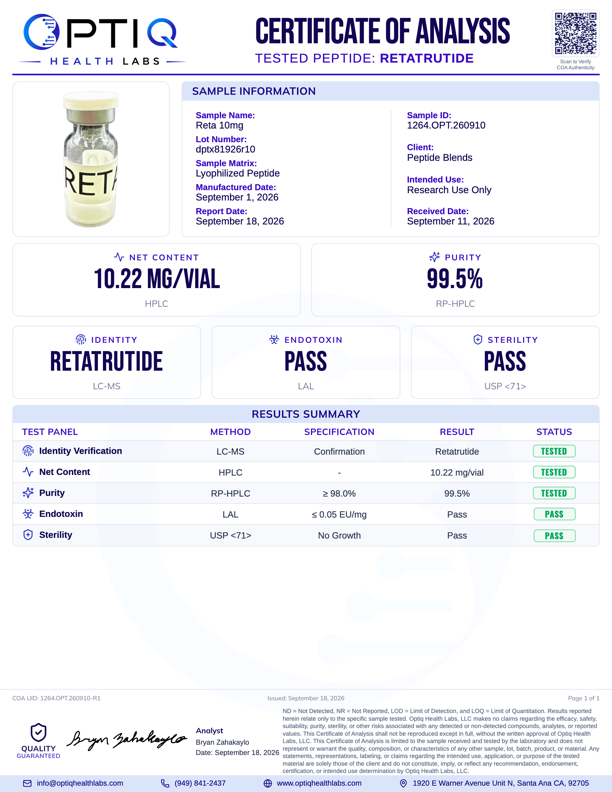
A Croix Project COA for a specific Retatrutide 30 mg sample provides a useful example.
The documentation identifies:
Compound
Retatrutide
Nominal Strength
30 mg
Lot
kizn072426
Sample ID
1266.OPT.260910
Report Date
September 18, 2026
Measured Peptide Content
29.84 mg/vial
Reported Purity
99.7%
Identity
Tested
Endotoxin
Pass
Sterility
Pass
The important point is not simply that the report says 99.7%.
The useful analytical picture comes from connecting the purity result with the specific compound, strength, lot, sample ID, measured content, identity testing, endotoxin testing, sterility testing, laboratory report, and report date.
And those results remain specific to the sample identified in that report.
HOW CROIX HANDLES COAs
TRACEABILITY BEFORE MARKETING CLAIMS
Croix treats analytical documentation as sample-specific evidence.
Before a COA is associated with a product, the relevant documentation should be checked for:
Product
Strength
Lot or batch
Sample ID
Laboratory
Report date
Available analytical results are then presented according to what the laboratory actually tested.
CROIX DOES NOT TREAT A COA AS:
Proof of FDA approval
Proof of clinical effectiveness
Proof of medical suitability
Evidence supporting an unrelated lot
A substitute for clinical research
A guarantee about every vial carrying the same product name
WHY THIS MATTERS
Analytical transparency is most useful when the documentation remains connected to the specific sample from which the analytical results were obtained.
THE SIMPLE VERSION
FIVE QUESTIONS TO REMEMBER
When you open a peptide COA, ask:
1. WHAT SAMPLE WAS TESTED?
Check product, strength, lot, and sample ID.
2. WHO TESTED IT?
Identify the laboratory and report date.
3. WAS IDENTITY CONFIRMED?
Look for appropriate identity testing.
4. WHAT EXACTLY WAS MEASURED?
Separate peptide content, purity, endotoxin, and sterility.
5. WHAT DOES THE REPORT NOT ESTABLISH?
Do not extend analytical findings into claims about clinical safety, efficacy, FDA approval, or unrelated lots.
MATCH THE SAMPLE → IDENTIFY THE TEST → READ THE RESULT → CHECK THE LIMITATIONS
RESEARCH REFERENCES
AUTHORITATIVE RESOURCES
U.S. Pharmacopeia
USP General Chapter <71> — Sterility Tests
Established compendial framework for sterility testing.
U.S. Pharmacopeia
USP General Chapter <85> — Bacterial Endotoxins Test
Compendial framework addressing bacterial endotoxin testing.
U.S. Food & Drug Administration
High Performance Liquid Chromatographic (HPLC) Methods
Regulatory resources concerning chromatographic analytical methods.
U.S. Food & Drug Administration
Analytical Procedures and Methods Validation for Drugs and Biologics
FDA guidance addressing analytical procedures and validation principles.
International Council for Harmonisation (ICH)
Q2 — Validation of Analytical Procedures
International framework addressing validation characteristics for analytical procedures.
ANALYTICAL NOTE
The meaning of an analytical result depends on the specific method, laboratory procedure, sample preparation, specifications, detection limits, and reporting conventions used.
Individual laboratory reports should therefore be interpreted according to the information contained in the complete report.
RESEARCH & EDUCATIONAL INFORMATION
This article is provided for research and educational reference and does not constitute individualized medical advice.
A Certificate of Analysis can provide valuable information about a specific tested sample, but the meaning of the report depends on what was actually tested and how the testing was performed.
Identity, peptide content, purity, endotoxin, and sterility represent different analytical questions and should not be treated as interchangeable measurements.
A COA does not establish clinical effectiveness, medical suitability, appropriate dosing, or FDA approval.
Throughout the Croix Research Library, analytical documentation is presented according to the specific product, strength, lot or batch, sample ID, laboratory, report date, test method, and reported result whenever that information is available.
Analytical evidence tells us about the tested sample. Clinical evidence tells us what happens in people. The two should never be confused.
Continue Learning: explore more articles
RESEARCH FOUNDATIONS
Human vs. Preclinical Research
Why results from cells, animals and humans answer different questions.
Understanding Clinical Trial Phases
What Phase 1, Phase 2 and Phase 3 studies are designed to investigate.
FDA Approved vs. Off Label vs. Investigational
Terms that are frequently confused in discussions of peptide research.
LABORATORY & QUALITY
How to Read a Certificate of Analysis
HPLC and Peptide Purity Explained
Identity, Sterility & Endotoxin Testing Explained
What a COA Can and Cannot Tell You