HUMAN VS PRECLINICAL RESEARCH
RESEARCH LIBRARY • EVIDENCE FUNDAMENTALS
Understanding What the Evidence Actually Shows
Scientific research does not begin with large human clinical trials. Most compounds are first investigated in laboratory systems and animal models before researchers consider studying them in people.
These early studies can reveal important biological mechanisms and identify promising areas for further investigation. But they cannot establish that the same effects will occur safely or meaningfully in humans.
Understanding the difference between preclinical research and human clinical evidence is essential when evaluating peptides and other investigational compounds.
THE EVIDENCE PATHWAY
FROM BIOLOGICAL IDEA TO HUMAN EVIDENCE
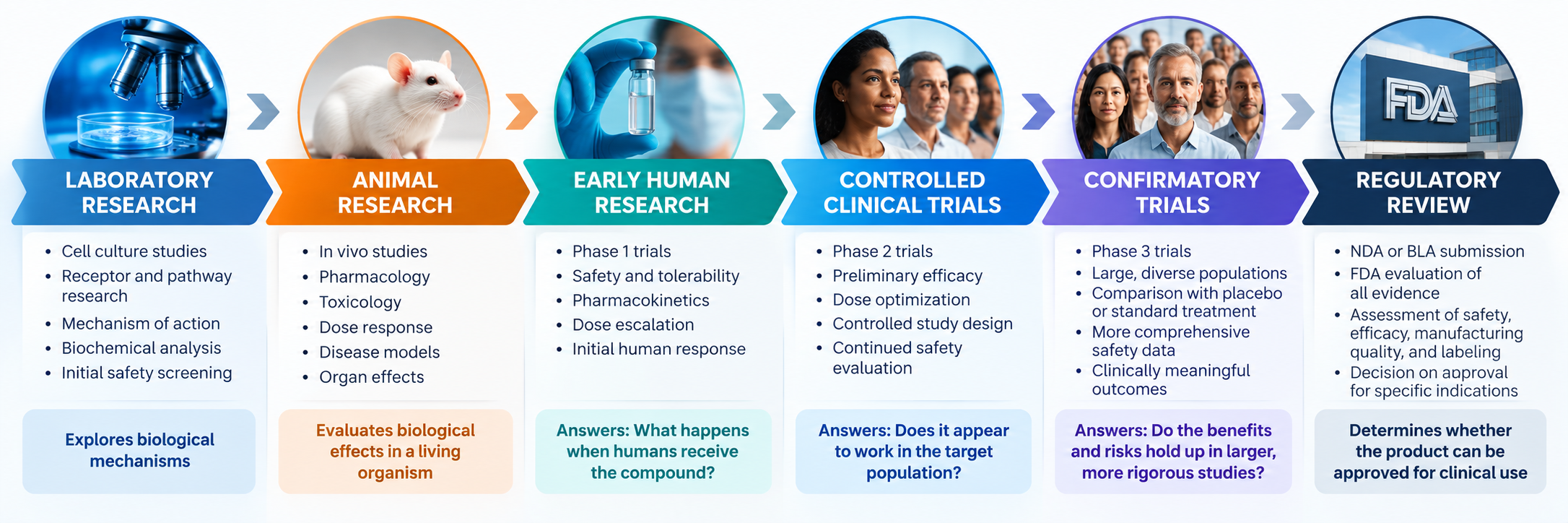
Research usually develops in stages.
A simplified pathway looks like this:
Each stage answers different questions.
Early research may ask:
Does the compound interact with the intended biological pathway?
Does it affect cells in a laboratory?
Does it produce measurable effects in animals?
Does it appear toxic at certain exposures?
Human research asks a different set of questions:
What happens when people receive it?
Is it reasonably safe?
What dose or exposure should be studied?
Does it produce a meaningful clinical effect?
Do the benefits outweigh the risks?
THE CENTRAL PRINCIPLE
Evidence that a compound does something biologically interesting is not the same as evidence that it produces a safe and meaningful benefit in humans.
WHAT IS PRECLINICAL RESEARCH?
PRECLINICAL RESEARCH
Preclinical research occurs before traditional human clinical testing and generally includes laboratory and animal studies.
Its purpose is to investigate the biology of a compound and determine whether further development may be justified.
Preclinical research can examine:
Mechanism of action
Receptor activity
Cell signaling
Pharmacology
Pharmacokinetics
Toxicology
Organ effects
Dose-response relationships
Potential therapeutic pathways
PRECLINICAL RESEARCH CAN BE HIGH QUALITY
Calling research “preclinical” does not mean it is poor science.
A carefully designed animal or laboratory experiment can provide valuable information about biological mechanisms.
The limitation is translation.
The study was not performed in humans, so its findings cannot establish what will happen in humans.
LABORATORY RESEARCH
IN VITRO RESEARCH
In vitro research generally refers to experiments performed outside a living organism.
Researchers may study:
Isolated cells
Cell cultures
Proteins
Receptors
Enzymes
Tissue samples
Biochemical systems
These experiments can help researchers understand how a compound interacts with a biological target.
WHAT IN VITRO RESEARCH CAN TELL US
Laboratory studies may demonstrate that a compound:
Activates a receptor
Suppresses a signaling pathway
Changes gene expression
Influences cell migration
Affects inflammatory markers
Alters cellular metabolism
WHAT IT CANNOT ESTABLISH
A result in isolated cells does not tell us whether an effective concentration can safely be achieved in a human body.
Living organisms introduce many additional variables, including:
Absorption
Distribution
Metabolism
Elimination
Immune responses
Hormonal regulation
Organ interactions
Off-target effects
A compound that performs impressively in a laboratory may behave very differently in a living person.
ANIMAL RESEARCH
IN VIVO PRECLINICAL RESEARCH
In vivo means research conducted within a living organism.
Before human trials, this commonly involves animal models.
Researchers may use animals to investigate:
Pharmacokinetics
Toxicity
Organ effects
Dose response
Disease models
Wound healing
Metabolic effects
Neurological effects
Reproductive effects
Potential therapeutic activity
WHY ANIMAL MODELS ARE USEFUL
Unlike isolated cells, an animal model allows researchers to observe a compound within an integrated biological system.
The compound must interact with:
Circulation
Organs
Metabolism
Hormones
Immune systems
Nervous systems
Other physiological processes
This provides information that a cell culture cannot.
THE TRANSLATION PROBLEM
Humans are not simply larger versions of laboratory animals.
Species can differ in:
Receptor biology
Metabolism
Enzyme activity
Immune responses
Disease progression
Drug clearance
Toxicity
Effective dose
A compound can therefore produce a strong effect in an animal and little or no useful effect in humans.
HUMAN RESEARCH
WHAT CHANGES WHEN RESEARCH REACHES HUMANS?
Human research directly examines what happens when people are exposed to a compound or intervention.
Depending on the stage of development, researchers may investigate:
Safety
Tolerability
Pharmacokinetics
Pharmacodynamics
Dose response
Clinical efficacy
Adverse effects
Long-term outcomes
HUMAN EVIDENCE IS NOT ALL EQUAL
The phrase “human research” covers many different levels of evidence.
Human evidence may include:
Case reports
Case series
Observational studies
Retrospective analyses
Small uncontrolled trials
Phase 1 trials
Randomized controlled trials
Large Phase 3 trials
Long-term outcomes studies
These designs differ dramatically in their ability to establish safety, efficacy, and causation.
A HUMAN STUDY IS A STARTING POINT, NOT A GUARANTEE
A study involving humans is more directly relevant to human outcomes than an animal experiment.
But a tiny uncontrolled human study is not equivalent to a large randomized controlled trial.
WHY RANDOMIZED CONTROLLED TRIALS MATTER
SEPARATING AN EFFECT FROM EVERYTHING ELSE
Suppose people receive an experimental compound and report feeling better afterward.
Did the compound cause the improvement?
Possibly.
But other explanations may include:
Natural recovery
Placebo effects
Lifestyle changes
Other medications
Changes in diet or training
Differences between participants
Selective reporting
Expectation
Random variation
Well-designed controlled trials attempt to separate the actual treatment effect from these competing explanations.
RANDOMIZATION
Participants are assigned to treatment groups using a randomized process.
This helps balance known and unknown differences between groups.
CONTROL GROUPS
Researchers compare the intervention with something else, such as:
Placebo
Standard treatment
Another intervention
BLINDING
When appropriate, participants, investigators, or both may not know which treatment was assigned.
This helps reduce expectation and observer bias.
WHY THIS MATTERS
The more effectively a study controls alternative explanations, the more confidently researchers can attribute differences to the intervention itself.
WHY PRECLINICAL RESULTS OFTEN DO NOT TRANSLATE
PROMISING BIOLOGY CAN STILL FAIL IN HUMANS
A compound may look highly promising before human testing and still fail during clinical development.
There are several reasons.
THE DOSE MAY NOT TRANSLATE
An effective animal exposure may be difficult or unsafe to reproduce in humans.
THE BIOLOGY MAY DIFFER
The receptor, enzyme, pathway, or disease model may behave differently between species.
THE ENDPOINT MAY BE DIFFERENT
Improving a laboratory marker does not necessarily improve how a patient feels, functions, or survives.
TOXICITY MAY EMERGE
A compound may affect additional biological systems that were not apparent during early experiments.
THE EFFECT MAY BE TOO SMALL
A measurable biological effect may exist but not be large enough to provide meaningful clinical benefit.
HUMAN DISEASE IS COMPLEX
Experimental animal models often reproduce only selected features of a human disease.
Real patients may differ substantially in genetics, age, medications, environment, disease severity, and other factors.
PEPTIDES & THE EVIDENCE GAP
WHY THIS DISTINCTION MATTERS IN PEPTIDE RESEARCH
Many peptides discussed in research communities have extensive mechanistic or animal literature but comparatively little human clinical evidence.
This can create an evidence gap.
A compound may have:
A plausible mechanism
Multiple animal studies
Interesting cellular effects
Strong theoretical rationale
Years of research-community discussion
and still lack:
Large randomized human trials
Validated clinical dosing
Long-term human safety data
An FDA-approved indication
COMMON EXAMPLE OF OVERSTATEMENT
An animal study reports improved tendon healing.
That finding may reasonably support:
“The compound demonstrated effects on tendon healing in an animal model.”
It does not justify:
“The compound heals tendon injuries in humans.”
The second statement requires human evidence that the first statement does not provide.
MECHANISM VS CLINICAL OUTCOME
“HOW IT COULD WORK” IS DIFFERENT FROM “WHETHER IT WORKS”
Mechanistic research explains biological pathways.
For example, researchers may demonstrate effects involving:
VEGF
NF-κB
GLP-1 receptors
Growth hormone signaling
Actin regulation
Mitochondrial function
Collagen synthesis
Gene expression
These findings can be scientifically important.
But knowing that a compound affects a pathway does not establish a clinical outcome.
MECHANISM
What does the compound appear to do biologically?
CLINICAL EFFICACY
Does administering it meaningfully improve an outcome in humans?
Those are different questions requiring different evidence.
COMMON EVIDENCE INTERPRETATION MISTAKES
“STUDIES SHOW…”
This phrase is incomplete unless we know what kind of studies.
“Studies show improved healing” could mean:
A cell-culture experiment
A rat injury model
A small observational human study
A randomized controlled trial
A large Phase 3 program
Those are not equivalent.
“SCIENTIFICALLY PROVEN”
Scientific evidence rarely fits neatly into a simple proven/not-proven category.
A better question is:
What evidence exists, and how strong is it?
“IT WORKED IN ANIMALS”
Animal evidence can justify further research.
It does not establish human effectiveness.
“THERE'S A HUMAN STUDY”
Ask:
How many participants?
Was it randomized?
Was there a control group?
What was measured?
How long did it last?
Was it peer reviewed?
Was the result statistically and clinically meaningful?
“THERE'S NO HUMAN EVIDENCE, BUT THE MECHANISM MAKES SENSE”
A plausible mechanism can support a hypothesis.
It cannot substitute for clinical evidence.
HOW TO READ A RESEARCH CLAIM
FIVE QUESTIONS TO ASK
When Croix evaluates a research claim, the first question should not simply be:
“Is there a study?”
Instead, ask:
1. WHAT WAS STUDIED?
Cells, animals, healthy volunteers, or patients?
2. WHAT COMPOUND WAS ACTUALLY TESTED?
Was it the same molecule, formulation, route, and product being discussed?
3. WHAT OUTCOME WAS MEASURED?
A biological marker or an actual clinical outcome?
4. HOW WAS THE STUDY DESIGNED?
Randomized? Controlled? Blinded? Observational?
5. WHAT CAN THE STUDY REASONABLY SUPPORT?
Mechanistic interest, preliminary human evidence, or a meaningful clinical conclusion?
These questions help prevent research from being represented more strongly than the evidence allows.
THE EVIDENCE HIERARCHY
A PRACTICAL CROIX FRAMEWORK
For the Croix Research Library, evidence can be understood as a progression:
LABORATORY EVIDENCE
Cells, receptors, biochemical systems, and isolated tissues.
Useful for: mechanism and biological plausibility.
ANIMAL EVIDENCE
Research conducted in living non-human organisms.
Useful for: integrated biology, pharmacology, toxicity, and preliminary efficacy.
LIMITED HUMAN EVIDENCE
Case reports, observational research, small trials, or preliminary studies.
Useful for: early human signals.
CONTROLLED HUMAN EVIDENCE
Randomized or otherwise well-controlled clinical studies.
Useful for: evaluating whether an intervention actually produces a human effect.
CONFIRMATORY HUMAN EVIDENCE
Larger and often later-phase clinical programs that reproduce findings across substantial populations.
Useful for: establishing a much stronger benefit-risk evidence base.
REGULATORY APPROVAL
A regulatory authority has evaluated a specific product for defined conditions of use.
Important: FDA approval is a regulatory determination, not simply another research study.
HOW CROIX PRESENTS RESEARCH
KEEPING EVIDENCE IN CONTEXT
Throughout Croix Compound Research Profiles, evidence should be labeled according to what actually exists.
When evidence is primarily animal-based, we identify it as preclinical.
When human evidence is small or preliminary, we identify it as limited human evidence.
When a compound has undergone substantial randomized clinical investigation, we distinguish that stronger evidence accordingly.
When a compound remains investigational, we do not describe preclinical findings as established therapeutic benefits.
When FDA-approved drug products exist, we distinguish those products and their approved uses from unrelated research-grade, compounded, or investigational materials.
WHY THIS MATTERS
Responsible research education is not about dismissing early science.
It is about describing early science accurately.
Promising research can be promising without being presented as proven.
RESEARCH REFERENCES
AUTHORITATIVE RESOURCES
U.S. Food & Drug Administration
The Drug Development Process
FDA overview of discovery, preclinical research, clinical research, regulatory review, and postmarket monitoring.
U.S. Food & Drug Administration
Step 2: Preclinical Research
FDA educational material explaining laboratory and animal research before human clinical testing.
U.S. Food & Drug Administration
Step 3: Clinical Research
FDA overview of human clinical research and clinical-trial development.
National Institutes of Health / ClinicalTrials.gov
Learn About Studies
Educational resources explaining clinical research design and terminology.
National Center for Advancing Translational Sciences
Translational science resources addressing the process of moving discoveries from laboratory research toward human health applications.
RESEARCH NOTE
There is no single study design that answers every scientific question.
Laboratory, animal, observational, and randomized human research each serve legitimate purposes.
The key is to interpret each type of evidence within the limits of what that research design can actually demonstrate.
RESEARCH & EDUCATIONAL INFORMATION
This article is provided for research and educational reference and does not constitute individualized medical advice.
Preclinical research can provide valuable information about mechanisms, biological activity, pharmacology, and potential safety concerns. It does not establish that the same effects will occur safely or meaningfully in humans.
Human evidence also varies substantially in strength. Case reports, observational studies, early clinical trials, randomized controlled trials, and large confirmatory studies should not be treated as equivalent.
Throughout the Croix Research Library, laboratory evidence, animal research, human clinical evidence, investigational status, and FDA-approved drug products are distinguished so that scientific findings are presented according to the strength of the evidence supporting them.
Continue Learning: explore more articles
RESEARCH FOUNDATIONS
Human vs. Preclinical Research
Why results from cells, animals and humans answer different questions.
Understanding Clinical Trial Phases
What Phase 1, Phase 2 and Phase 3 studies are designed to investigate.
FDA Approved vs. Off Label vs. Investigational
Terms that are frequently confused in discussions of peptide research.
LABORATORY & QUALITY
How to Read a Certificate of Analysis
HPLC and Peptide Purity Explained
Identity, Sterility & Endotoxin Testing Explained