FDA APPROVED VS. OFF LABEL VS. INVESTIGATIONAL
RESEARCH LIBRARY • REGULATORY & EVIDENCE FUNDAMENTALS
Three Terms That Mean Very Different Things
“FDA approved,” “off label,” and “investigational” are often used interchangeably in online discussions about medications and peptides.
They should not be.
Each term describes a fundamentally different regulatory situation. Understanding those differences is essential when evaluating a compound, interpreting clinical research, or determining what an FDA approval actually applies to.
THE THREE CATEGORIES
START WITH THE BASIC DISTINCTION
At the simplest level:
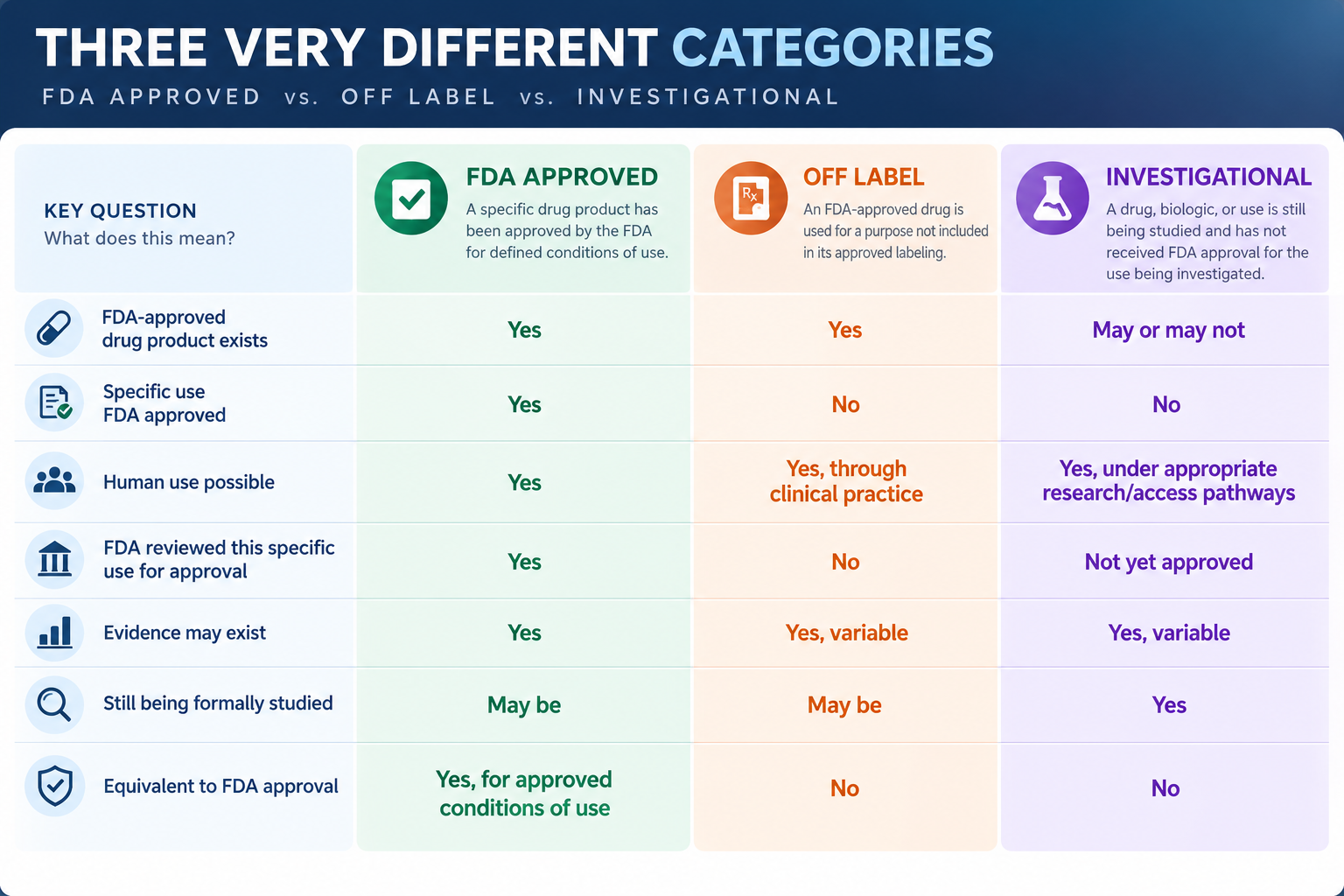
FDA APPROVED
A specific drug product has undergone FDA review and been approved for defined conditions of use.
OFF LABEL
An FDA-approved drug is prescribed or administered for a use that is not included in its FDA-approved labeling.
INVESTIGATIONAL
A drug, biological product, or particular use is still being formally studied and has not received FDA approval for the use being investigated.
These categories may sound similar because all three can involve human use.
Regulatorily, however, they are very different.
WHAT DOES FDA APPROVED MEAN?
FDA APPROVED
Before FDA approves a new prescription drug, the sponsor submits evidence supporting the product's proposed use.
FDA reviews information addressing questions such as:
Does the evidence demonstrate effectiveness for the proposed indication?
What are the known risks?
Do the expected benefits outweigh those risks?
Is the proposed labeling appropriate?
Can the product be manufactured with adequate controls for identity, strength, quality, and purity?
When FDA determines that the applicable approval standards have been satisfied, the drug product can receive marketing approval. U.S. Food and Drug Administration
APPROVAL IS SPECIFIC
This is one of the most important concepts in the Croix Research Library.
FDA approval does not simply attach to a molecule in every possible form and use.
Approval applies to a specific drug product and approved labeling, which can define factors such as:
Indication
Patient population
Dose or dose range
Route of administration
Formulation
Strength
Warnings and precautions
Other conditions of use
IMPORTANT DISTINCTION
The existence of an FDA-approved drug containing a particular active ingredient does not automatically mean every product containing that ingredient is FDA approved.
That distinction is especially important when discussing peptides.
WHAT FDA APPROVAL DOES NOT MEAN
APPROVED DOES NOT MEAN “APPROVED FOR EVERYTHING”
Suppose a drug receives FDA approval for Condition A.
Researchers may later discover that the same drug could potentially help with:
Condition B
Condition C
A different patient population
A different dosing strategy
A different clinical outcome
The original FDA approval does not automatically expand to those additional uses.
They must be evaluated separately.
APPROVAL ALSO DOES NOT MEAN ZERO RISK
FDA approval does not mean a drug is completely safe or free of adverse effects.
Rather, FDA evaluates whether the available evidence supports the drug's benefits relative to its known and potential risks for the proposed conditions of use. U.S. Food and Drug Administration
Approved drugs may still carry:
Warnings
Contraindications
Boxed warnings
Drug interactions
Monitoring requirements
Serious adverse effects
FDA may also continue evaluating safety after approval.
WHAT IS OFF LABEL USE?
OFF LABEL
Once FDA has approved a drug, a licensed healthcare professional may generally prescribe or administer that approved drug in clinical practice for a use that is not included in its FDA-approved labeling, based on professional medical judgment. This is commonly called off-label use. U.S. Food and Drug Administration
An off-label use might involve:
A different disease
A different patient population
A different dose
A different dosing schedule
A different route of administration
Another use not included in the approved labeling
THE DRUG IS APPROVED
This is what distinguishes off-label use from use of an unapproved investigational drug.
With off-label prescribing:
The drug product is FDA approved.
But:
The particular use is not FDA approved.
OFF LABEL DOES NOT MEAN UNPROVEN
THE EVIDENCE CAN VARY DRAMATICALLY
An off-label use may have substantial supporting evidence.
In some areas of medicine, off-label prescribing can be supported by:
Randomized controlled trials
Professional guidelines
Peer-reviewed literature
Clinical experience
Expert consensus
In other situations, evidence may be considerably weaker.
Therefore:
“Off label” describes regulatory status. It does not, by itself, tell you how strong or weak the scientific evidence is.
TWO DIFFERENT QUESTIONS
Regulatory question:
Has FDA specifically approved this use?
Scientific question:
What evidence supports this use?
Those questions should be evaluated separately.
AN IMPORTANT PEPTIDE DISTINCTION
OFF LABEL REQUIRES AN APPROVED DRUG
This distinction is frequently misunderstood in peptide discussions.
If a compound has never been part of an FDA-approved drug product, describing its general human use as “off label” is usually not the correct framework.
Off-label use refers to an approved drug being used outside its approved labeling.
An unapproved research compound does not become “off label” simply because someone uses it for a different purpose.
FOR EXAMPLE
If an FDA-approved drug is prescribed for a condition outside its approved labeling:
Off label
If a research peptide has no FDA-approved drug product and remains under clinical investigation:
Investigational or unapproved, depending on the specific context
Those are not equivalent regulatory categories.
WHAT DOES INVESTIGATIONAL MEAN?
INVESTIGATIONAL
An investigational drug is being studied to determine whether it can safely and effectively be used for a particular purpose.
Investigational products may be studied through clinical trials involving human participants.
For many clinical investigations involving unapproved drugs, the sponsor operates under an Investigational New Drug application, or IND.
FDA explains that an IND allows a sponsor to proceed with clinical investigation while providing FDA an opportunity to evaluate whether participants would face unreasonable risk. U.S. Food and Drug Administration
AN IND IS NOT FDA APPROVAL
This distinction is critical.
An IND allows clinical investigation to proceed under the applicable regulatory framework.
It is not marketing approval.
FDA explicitly distinguishes the IND process from the application used to obtain permission to market an approved drug. U.S. Food and Drug Administration
INVESTIGATIONAL DOES NOT MEAN INEFFECTIVE
IT MEANS THE QUESTION IS STILL BEING STUDIED
Calling a compound investigational does not mean researchers have determined that it does not work.
An investigational compound may have:
Strong preclinical evidence
Phase 1 human evidence
Positive Phase 2 results
Positive Phase 3 results
Multiple peer-reviewed publications
A substantial development program
It can still remain investigational until the applicable regulatory approval has actually been granted.
POSITIVE TRIAL RESULTS ≠ FDA APPROVAL
A company may announce highly favorable Phase 3 results.
Those results may represent strong clinical evidence.
But until FDA approves the applicable product and use, the compound or indication remains outside that approval.
APPROVED DRUG, INVESTIGATIONAL USE
THE CATEGORIES CAN OVERLAP
A drug can be FDA approved and simultaneously be investigational for another use.
For example:
A drug is approved for Condition A.
Researchers conduct a formal clinical trial investigating it for Condition B.
For Condition A:
FDA approved
For routine clinical prescribing for Condition B:
Off label, if prescribed outside the approved labeling
Within a formal clinical investigation of Condition B:
Investigational use
FDA notes that an investigator IND can be used to study an approved product for a new indication or a new patient population. U.S. Food and Drug Administration
WHY CONTEXT MATTERS
Regulatory status cannot always be reduced to a single label attached permanently to the molecule.
The correct description may depend on:
The product
The indication
The formulation
The route
The population
Whether the context is clinical practice or formal research
INVESTIGATIONAL ACCESS
HOW CAN PEOPLE RECEIVE INVESTIGATIONAL DRUGS?
The primary way investigational drugs are studied in humans is through clinical trials.
In certain serious or life-threatening circumstances, investigational products may also potentially be accessed through mechanisms such as expanded access, sometimes called compassionate use.
FDA describes expanded access as a potential pathway for certain patients who cannot participate in a clinical trial and lack satisfactory approved therapeutic options. U.S. Food and Drug Administration
EXPANDED ACCESS IS NOT APPROVAL
Allowing an investigational product to be used through an expanded-access pathway does not convert that product into an FDA-approved drug.
The product remains investigational.
WHAT ABOUT RESEARCH GRADE PRODUCTS?
“RESEARCH GRADE” IS NOT A REGULATORY APPROVAL CATEGORY
This distinction is especially important for peptide research.
Terms such as:
Research grade
Research use only
Laboratory use
do not mean FDA approved.
They also do not mean the material is equivalent to the drug product used in a clinical trial.
A research material and an FDA-approved pharmaceutical product may differ in:
Manufacturing controls
Formulation
Purity specifications
Sterility requirements
Stability testing
Container and closure systems
Quality assurance
Regulatory oversight
RESEARCH MATERIAL ≠ CLINICAL TRIAL PRODUCT
A published study involving a pharmaceutical-grade investigational product does not automatically establish that an unrelated commercially available research material has the same identity, quality, pharmacology, safety, or clinical characteristics.
WHAT ABOUT COMPOUNDED DRUGS?
COMPOUNDED DOES NOT MEAN FDA APPROVED
Compounded medications occupy another distinct regulatory category.
The fact that a pharmacy compounds a preparation does not mean FDA has approved that compounded product.
Likewise, the presence of an active ingredient in an FDA-approved drug does not automatically make every compounded preparation containing that ingredient an FDA-approved product.
KEEP THE QUESTIONS SEPARATE
When evaluating a product, ask:
Is there an FDA-approved drug product?
Is this the FDA-approved product?
Is the intended use included in its approved labeling?
Is the preparation compounded?
Is the compound investigational?
What evidence supports the particular use?
Those questions answer different things.
SIDE-BY-SIDE COMPARISON
THREE VERY DIFFERENT CATEGORIES
THE SIMPLE VERSION
FDA APPROVED
The product and use have received FDA approval.
OFF LABEL
The drug is approved, but the particular use is not.
INVESTIGATIONAL
The product or use is still being formally investigated and has not received FDA approval for that purpose.
COMMON MISINTERPRETATIONS
“IT'S FDA APPROVED”
Ask:
Which product? For what indication? By what route?
Without those details, the statement may be misleading.
“DOCTORS USE IT, SO IT MUST BE APPROVED”
Not necessarily.
Physicians may prescribe FDA-approved drugs off label.
Clinical use alone does not establish that FDA approved that particular use.
“IT'S OFF LABEL”
Ask whether an FDA-approved drug product actually exists.
An unapproved research compound should not simply be reclassified as “off label.”
“IT'S IN PHASE 3, SO IT'S BASICALLY APPROVED”
No.
Phase 3 is a stage of clinical development.
FDA approval is a separate regulatory determination.
“IT HAS AN IND, SO FDA APPROVED IT”
No.
An IND facilitates clinical investigation. It is not authorization to market the product as an FDA-approved drug. U.S. Food and Drug Administration
“THE MOLECULE IS FDA APPROVED”
This phrasing can be misleading.
A more precise statement is:
“This active ingredient is contained in specific FDA-approved drug products.”
Then identify the approved product and use.
HOW CROIX DESCRIBES REGULATORY STATUS
PRECISION MATTERS
Throughout Croix Compound Research Profiles, regulatory status should be stated specifically.
FDA APPROVED
Use when the relevant drug product and indication have received FDA approval.
FDA APPROVED FOR ANOTHER INDICATION
Use when an approved drug is being discussed in connection with a use outside its approved labeling.
INVESTIGATIONAL
Use when a compound or use remains under formal investigation and has not received FDA approval for that purpose.
NOT FDA APPROVED
Use when no applicable FDA marketing approval exists.
PRECLINICAL RESEARCH
Use when evidence primarily comes from laboratory or animal studies.
IMPORTANT PRINCIPLE
Croix should not convert:
Clinical-trial participation into FDA approval
Compounding into FDA approval
A research-use label into clinical authorization
Approval of one product into approval of unrelated products
Approval for one indication into approval for every possible use
WHY THIS MATTERS FOR PEPTIDE RESEARCH
THE SAME WORD CAN HIDE VERY DIFFERENT EVIDENCE
The peptide landscape contains compounds at dramatically different stages of development.
Some active ingredients are contained in FDA-approved prescription drug products with extensive human clinical evidence.
Others are undergoing Phase 1, Phase 2, or Phase 3 investigation.
Others remain supported primarily by animal or laboratory research.
Treating all of these compounds as if they occupy the same regulatory category creates a distorted picture of the evidence.
A BETTER APPROACH
For every compound, ask:
What exact product are we discussing?
What indication is being discussed?
What human evidence exists?
What stage of clinical development has been reached?
Has FDA actually approved this product for this use?
That provides far more useful information than simply asking whether a peptide is “legal” or “approved.”
RESEARCH REFERENCES
AUTHORITATIVE RESOURCES
U.S. Food & Drug Administration
Approved Drugs: Questions and Answers
FDA explanation of the drug approval process and how FDA evaluates evidence supporting proposed uses. U.S. Food and Drug Administration
U.S. Food & Drug Administration
Understanding FDA Terms for Possible New Therapies to Prevent and Treat Diseases
FDA consumer guidance explaining approved products, off-label use, and other regulatory terminology. U.S. Food and Drug Administration
U.S. Food & Drug Administration
Investigational New Drug Application (IND)
FDA explanation of the regulatory framework allowing investigational drugs to enter human clinical research. U.S. Food and Drug Administration
U.S. Food & Drug Administration
New Drug Application (NDA)
FDA explanation of the application through which a sponsor requests marketing approval for a new drug. U.S. Food and Drug Administration
U.S. Food & Drug Administration
Learn About Expanded Access and Other Treatment Options
FDA information addressing investigational drugs, expanded access, and off-label use. U.S. Food and Drug Administration
REGULATORY NOTE
Regulatory terminology can depend on the specific product, indication, route, formulation, population, and context of use.
Statements about approval should therefore identify exactly what FDA has approved rather than broadly applying an approval to a molecule or class of products.
RESEARCH & EDUCATIONAL INFORMATION
This article is provided for research and educational reference and does not constitute individualized medical or legal advice.
FDA approved, off label, and investigational are not interchangeable terms.
FDA approval applies to specific drug products and defined conditions of use. Off-label use involves an FDA-approved drug being used outside its approved labeling. Investigational products or uses remain under study and have not received FDA approval for the purpose being investigated.
Throughout the Croix Research Library, regulatory status is presented separately from the strength of scientific evidence so that FDA approval, off-label medical practice, investigational research, and preclinical evidence remain clearly distinguished.
Continue Learning: explore more articles
RESEARCH FOUNDATIONS
Human vs. Preclinical Research
Why results from cells, animals and humans answer different questions.
Understanding Clinical Trial Phases
What Phase 1, Phase 2 and Phase 3 studies are designed to investigate.
FDA Approved vs. Off Label vs. Investigational
Terms that are frequently confused in discussions of peptide research.
LABORATORY & QUALITY
How to Read a Certificate of Analysis
HPLC and Peptide Purity Explained
Identity, Sterility & Endotoxin Testing Explained