


CROIX WELLNESS | RESEARCH & EDUCATION
Peptides Aren't Magic: Why Cellular Health, Mitochondria, and Lifestyle Matter
Understanding why sleep, nutrition, exercise, metabolic health, and biological timing remain the foundation of wellness, even when peptide therapies are involved.
October 18, 2026 | Estimated reading time: 9 minutes
Peptides have attracted growing interest for their potential roles in metabolic health, hormone signaling, tissue repair, body composition, and healthy aging. Some peptide-based medications have demonstrated substantial clinical benefits. Others remain experimental, with promising laboratory findings but limited evidence in humans.
Yet one of the most important principles often gets lost in conversations about peptides:
Peptides are not magic. They do not replace the fundamental biological processes that keep the human body healthy.
A compound may influence a signaling pathway, but the body's response also depends on factors such as nutritional status, sleep, physical activity, underlying disease, and the function of its cells and organs.
This does not mean every peptide requires perfectly healthy cells to work. Nor does it mean that improving mitochondrial health automatically makes a peptide more effective. Those claims would go beyond current evidence.
Instead, the more scientifically defensible principle is that medications and healthy behaviors influence overlapping biological systems, and the benefits of one do not eliminate the importance of the other.
1. Peptides are signals, not shortcuts
Peptides are chains of amino acids. In the human body, many naturally occurring peptides function as signaling molecules, helping cells communicate and coordinate biological processes.
Depending on their structure and receptor targets, peptide-based medications may influence appetite, glucose regulation, growth hormone secretion, or other physiological pathways.
For example, semaglutide and tirzepatide act on hormone receptors involved in metabolic regulation. Tesamorelin stimulates the growth hormone pathway.
However, activating a biological pathway is not the same thing as guaranteeing a particular health outcome.
A peptide cannot independently provide all the nutrients required for tissue maintenance, replace resistance training as a stimulus for muscle development, or eliminate the consequences of chronic sleep deprivation.
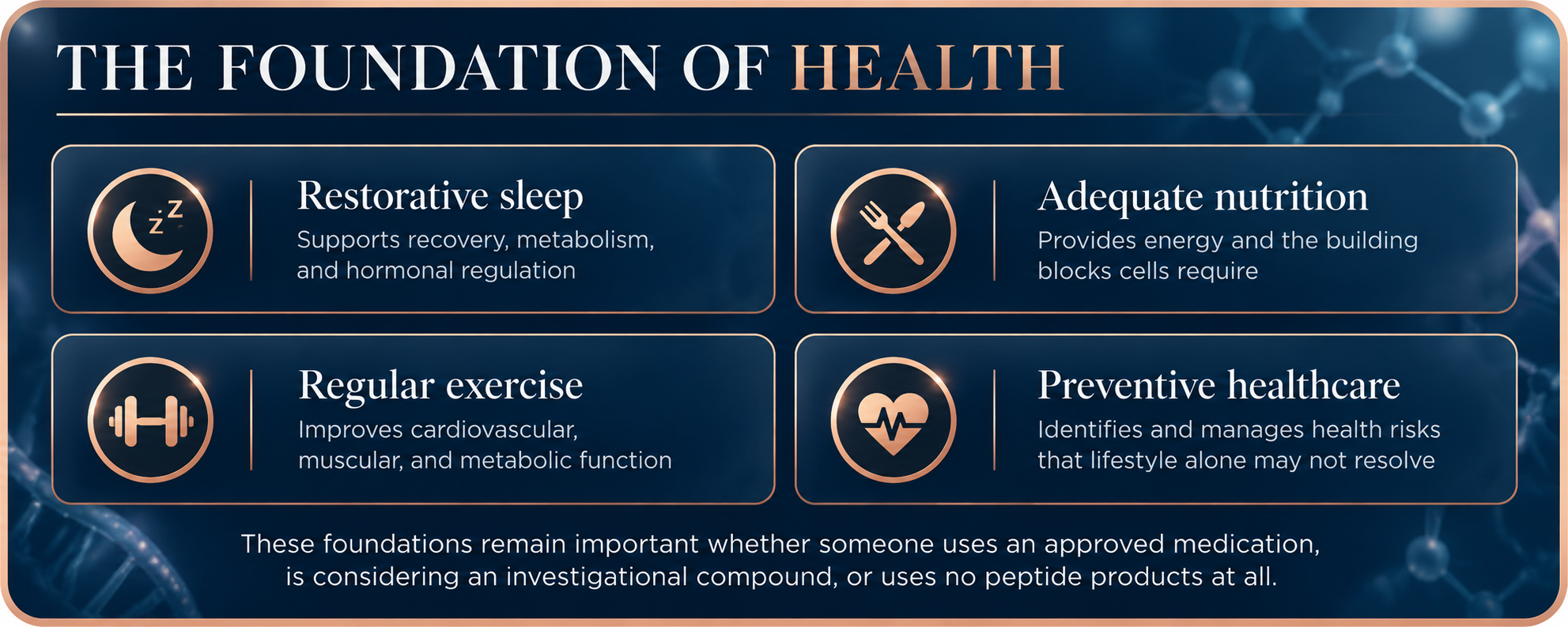
2. Mitochondria: The energy systems inside our cells


Mitochondria are cellular organelles involved in energy production, metabolism, calcium regulation, and cellular signaling.
Their best-known function is producing adenosine triphosphate (ATP), the molecule that powers many energy-dependent processes throughout the body.
Mitochondria also participate in:
Regulating cellular responses to metabolic stress
Coordinating aspects of programmed cell death
Maintaining cellular redox balance
Supporting muscle metabolism and exercise adaptation
Communicating with other cellular systems
Mitochondrial health is more complex than simply producing more ATP or increasing the number of mitochondria.
Healthy mitochondrial function involves maintaining appropriate energy production, adapting to changing demands, repairing damage, and removing dysfunctional components through cellular quality-control processes.
Why mitochondrial function matters for fitness
Skeletal muscle contains mitochondria that help sustain repeated contractions, particularly during endurance activities.
Aerobic exercise stimulates adaptations that can improve mitochondrial oxidative capacity and metabolic efficiency.
Resistance training also supports metabolic health, although its most prominent adaptations include muscular strength, hypertrophy, and neuromuscular function.
These changes are supported by extensive human exercise research.
By contrast, many products marketed as mitochondrial peptides have considerably less clinical evidence.
MOTS-c and SS-31 (elamipretide), for example, should not be treated as interchangeable or as universally proven mitochondrial-enhancing therapies. Their mechanisms, research histories, clinical evidence, and regulatory status differ.
The practical takeaway is that exercise has far stronger evidence for improving physical fitness and metabolic health than most investigational mitochondrial peptides.
3. Cellular health depends on more than energy
Healthy cells require much more than functioning mitochondria.
They depend on coordinated processes involving membranes, proteins, DNA, nutrients, waste removal, and communication with surrounding tissues.

Nutrition supplies the raw materials
Proteins provide amino acids required for tissue maintenance and repair. Dietary fats contribute to cell membranes and other physiological functions. Carbohydrates and fats supply energy, while vitamins and minerals participate in numerous metabolic reactions.
Severe energy restriction, inadequate protein intake, and nutrient deficiencies can compromise health and recovery.
For individuals trying to preserve muscle during weight loss, adequate protein and resistance training are especially important.
Inflammation requires balance
Inflammation is not universally harmful. Acute inflammatory responses are essential for fighting infections and repairing damaged tissue.
Problems can arise when inflammatory signaling becomes chronically dysregulated.
Exercise, sleep, dietary patterns, obesity, chronic illness, and other factors can influence inflammatory pathways.
However, the claim that a peptide can broadly eliminate harmful inflammation or accelerate healing in humans requires compound-specific clinical evidence.
Cellular repair is a continuous process
Cells maintain themselves through numerous systems, including DNA repair, protein recycling, and autophagy.
Autophagy helps cells recycle damaged or unnecessary components, while mitophagy is a specialized process involving mitochondria.
These systems are biologically important, but greater activity is not always better. Cellular maintenance requires regulation and balance.
The popularity of longevity-related peptides has sometimes led to exaggerated claims about autophagy, cellular rejuvenation, and biological age reversal. Such claims should not be accepted without convincing human clinical evidence.
4. Exercise: One of the most effective ways to support cellular health

Exercise is one of the most thoroughly researched interventions for improving metabolic health, cardiovascular fitness, and physical function.
Different forms of exercise stimulate different adaptations.
Types of exercises and their primary benefits:
Resistance training
Strength, muscle maintenance, bone health, insulin sensitivity
Aerobic exercise
Cardiovascular fitness, mitochondrial adaptations, endurance
High-intensity intervals
Cardiorespiratory fitness and metabolic adaptations
Walking and daily movement
Glucose regulation, energy expenditure, cardiovascular health
Mobility and balance training
Movement function, coordination, fall prevention
For adults, widely established public-health recommendations include at least 150 minutes of moderate-intensity aerobic activity weekly, or 75 minutes of vigorous activity, plus muscle-strengthening activities on at least two days.
These are general targets, not a requirement that everyone train at the same intensity.
Why exercise still matters during peptide therapy
Consider someone receiving an approved weight-management medication.
A reduction in appetite and body weight may improve metabolic health, but weight loss can include both fat and lean tissue.
Resistance training and appropriate nutrition can help support muscle retention during weight reduction.
Likewise, a compound that influences growth hormone signaling does not eliminate the need for progressive resistance training, adequate recovery, and sufficient nutrition.
A biological signal and a physical training stimulus are not the same thing.
5. Sleep: The recovery process you cannot replace
Sleep influences nearly every major system involved in health and recovery.
During sleep, the body coordinates numerous processes related to neural function, metabolism, immune regulation, and endocrine signaling.
Chronic sleep restriction can negatively affect insulin sensitivity, appetite regulation, mood, and physical performance.
Sleep also interacts with growth hormone physiology. Growth hormone secretion normally follows a pulsatile pattern, with important relationships to sleep, particularly slow-wave sleep.
This does not mean that artificially manipulating growth hormone secretion can replace restorative sleep.
For most adults, regularly obtaining approximately seven to nine hours of sleep is a reasonable goal, although individual requirements vary.
Sleep quality matters alongside duration
A person sleeping eight hours but experiencing untreated sleep apnea, frequent awakenings, or significant circadian disruption may still experience impaired recovery.
Improving sleep may involve consistent schedules, managing caffeine and alcohol intake, treating underlying sleep disorders, and creating an appropriate sleep environment.
These interventions have established health relevance independent of peptide use.
6. Timing matters, but not all peptide timing claims are proven
Biological timing is an important scientific concept.
Human physiology follows circadian rhythms that influence hormone secretion, glucose metabolism, body temperature, alertness, and sleep.
Meal timing and exercise timing can also affect certain short-term metabolic responses.
However, the importance of timing differs substantially among medications.
For example:
Semaglutide injections can generally be administered without regard to meals, according to product-specific prescribing instructions.
Tirzepatide injections can likewise be administered without regard to meals.
Some medications have specific food-related administration requirements.
Growth hormone secretion follows physiological rhythms, but that does not establish a universally optimal injection time for investigational growth hormone secretagogues.
Claims that all peptides work best when taken fasting, before bed, or immediately after exercise are not scientifically justified.
Similarly, avoiding food for a particular number of hours may be part of an individual experimental protocol, but it should not be presented as an established clinical requirement without supporting evidence.
The correct approach is to follow approved prescribing information when available and distinguish experimental practices from validated recommendations.
7. Metabolic health: The environment in which cells operate
Metabolic health involves the body's ability to regulate energy availability, glucose, lipids, and other physiological processes.
Insulin resistance, poorly controlled diabetes, hypertension, and abnormal lipid levels can increase long-term health risks.
These conditions may also influence recovery, physical performance, and overall well-being.
Important indicators can include blood pressure, glucose or HbA1c, lipid measurements, body composition, and cardiovascular fitness.
A person can feel energetic while having elevated blood pressure or abnormal glucose levels. That is one reason preventive healthcare and appropriate laboratory testing matter.
Yet laboratory results must be interpreted in context. A single biomarker rarely captures the entire picture of cellular or mitochondrial health.
8. More peptides do not necessarily produce better results
One of the most significant misconceptions in peptide discussions is that combining several compounds will automatically create stronger or more comprehensive benefits.
A proposed combination might target multiple pathways, but this does not establish that the combination is beneficial.
Using several compounds can introduce additional uncertainty regarding:
Drug interactions and overlapping biological effects
Additive adverse reactions
Changes in glucose regulation or hormone signaling
Product quality and contamination risks
Difficulty determining which compound caused a particular effect
Long-term consequences that have not been studied
For many investigational peptide combinations, controlled human safety and efficacy trials are absent.
A theoretically complementary mechanism is not proof of synergy.
This distinction is especially important for compounds marketed for mitochondrial function, tissue repair, inflammation, or longevity.
9. Building a stronger foundation for long-term health
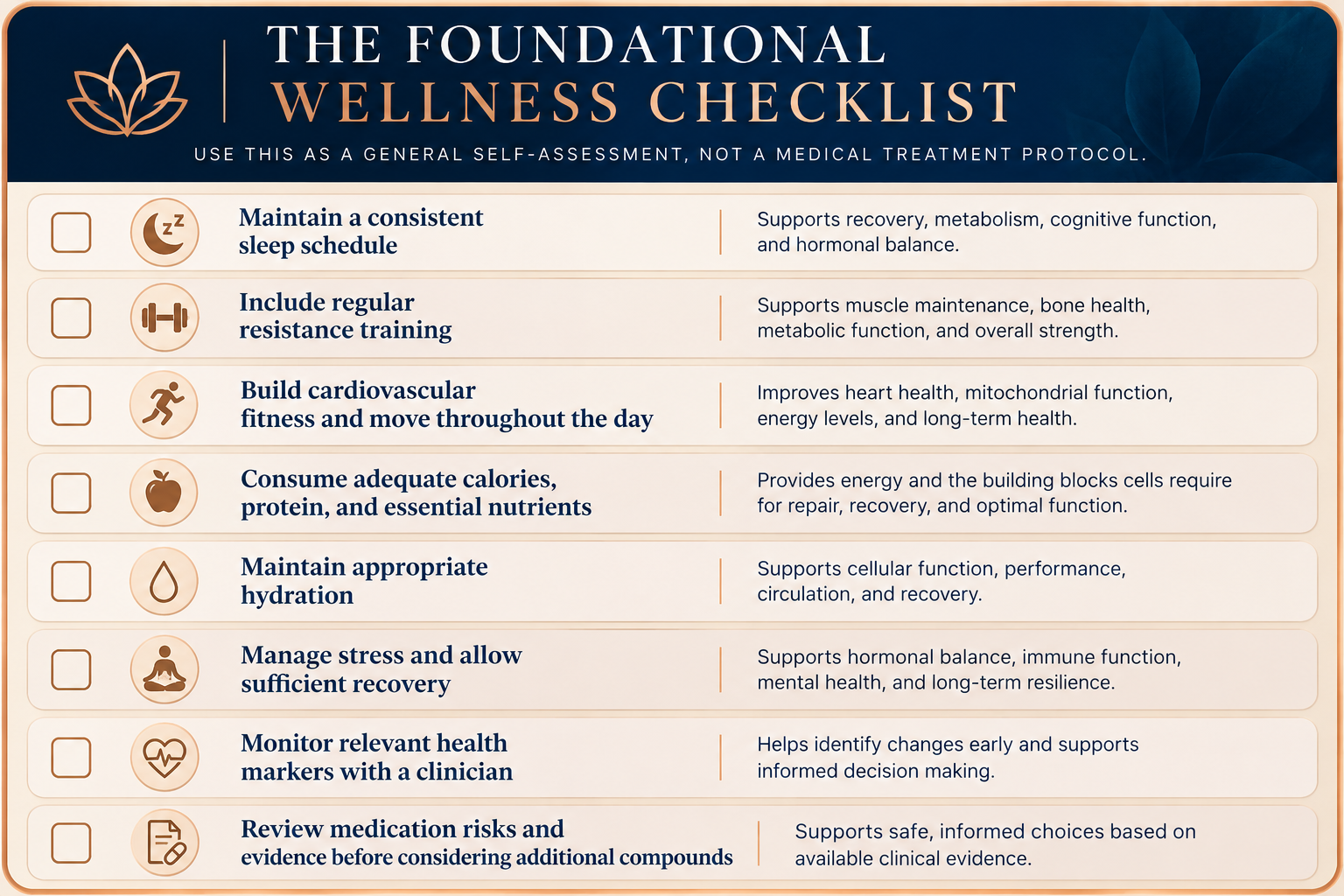
These practices do not guarantee disease prevention or eliminate the need for medical treatment. They do, however, represent interventions with substantial evidence supporting general health and physical function.
10. Where peptides fit into the bigger picture
There is an important difference between using an evidence-based medication for a diagnosed condition and using an investigational compound in hopes of optimizing an already healthy biological system.
FDA-approved peptide-based medications can provide meaningful clinical benefits, including for individuals who have difficulty achieving adequate disease control through lifestyle changes alone.
In those cases, medication is not a shortcut or a failure of healthy living. It is a legitimate component of medical care.
For investigational peptides, the balance is different. Proposed benefits may be based largely on animal studies, cellular experiments, small human trials, or theoretical mechanisms.
The biological plausibility of a compound does not establish its clinical effectiveness or safety.
Even when a peptide has a promising mechanism, important questions remain: Does it produce meaningful improvements in humans? At what exposure? For which population? With what adverse effects? And are the benefits sustained?
Until those questions are adequately answered, claims should remain appropriately cautious.
Conclusion: Build the foundation before chasing optimization
Mitochondrial function, cellular maintenance, metabolic health, physical fitness, sleep, and nutrition are interconnected.
Peptide-based medications may influence particular components of these systems, but they do not replace the need to support overall health.
For approved therapies, healthy lifestyle practices can complement evidence-based medical treatment. For investigational compounds, lifestyle improvements cannot establish safety or effectiveness where adequate clinical evidence is missing.
The strongest approach to long-term wellness is not built around finding a compound for every biological pathway.
It is built around understanding how the body functions, supporting the processes we can reliably influence, treating medical conditions appropriately, and evaluating new therapies according to the quality of their evidence.
Peptides aren't magic. Healthy living isn't magic either. But consistent, evidence-based choices remain among the most powerful tools available for supporting human health.
Scientific references and further reading
The following authoritative resources provide background on the physiological concepts discussed in this article:
World Health Organization — Physical Activity. Evidence-based recommendations and health benefits of regular exercise.
CDC — About Sleep. Sleep duration, quality, and health.
NIH/NIDDK — Weight Management. Nutrition, physical activity, and evidence-based weight management.
DailyMed — Official Medication Labeling. Prescribing information for approved medications, including peptide-based therapies.
FDA — Compounding Substances With Significant Safety Risks. Safety concerns and evidence gaps for certain investigational peptides.
PubMed — Exercise and Skeletal Muscle Mitochondrial Adaptations. Peer-reviewed research on exercise-related mitochondrial adaptations.
Croix Wellness | Research & Education | October 2026 This article is intended for general education. It is not individualized medical advice, a peptide administration protocol, or an endorsement of unapproved compounds for human use. Clinical decisions should be made with an appropriately qualified healthcare professional.